Description
Cost Calculator
General specifications of standard business cards
| Print run: | Quantity of 100 and 1000 business cards |
|---|---|
| Size: | 3.5" x 2" |
| Paper: | Coated, matte paper with a density of 350 g/m² + designer cardboards to choose from |
| Printing Type: | Digital Printing |
| Packing: | Plastic box with our logo for kits of 100 pieces and a cardboard box for kits of 1000 pieces |
Price of standard business cards
| Print run | Price | Production time |
|---|---|---|
| 25 pcs (single sided) | $14.90 | 3-5 Business days |
| 100 pcs (double sided) | $28.15 | 3-5 Business days |
| 1000 pcs (single sided) | $47.80 | 3-5 Business days |
| 1000 pcs (double sided) | $67.85 | 3-5 Business days |
A Guide to the Best Business Cards Printing Services
The Trick To Creating The PERFECT Business Card Design With Online Tools
Design your own business card online with our easy-to-use tool. Simply choose a template or upload your design to create one-of-a-kind custom business cards in minutes.
How To Choose The Right Paper Stock For Your Business Card Printing Project
Paper is the most common material for print media. It has been used since the invention of the printing press in 1440. Today, there are different paper types available for use in various industries such as print services, graphic design, and advertising agencies.
Business card layout file requirements
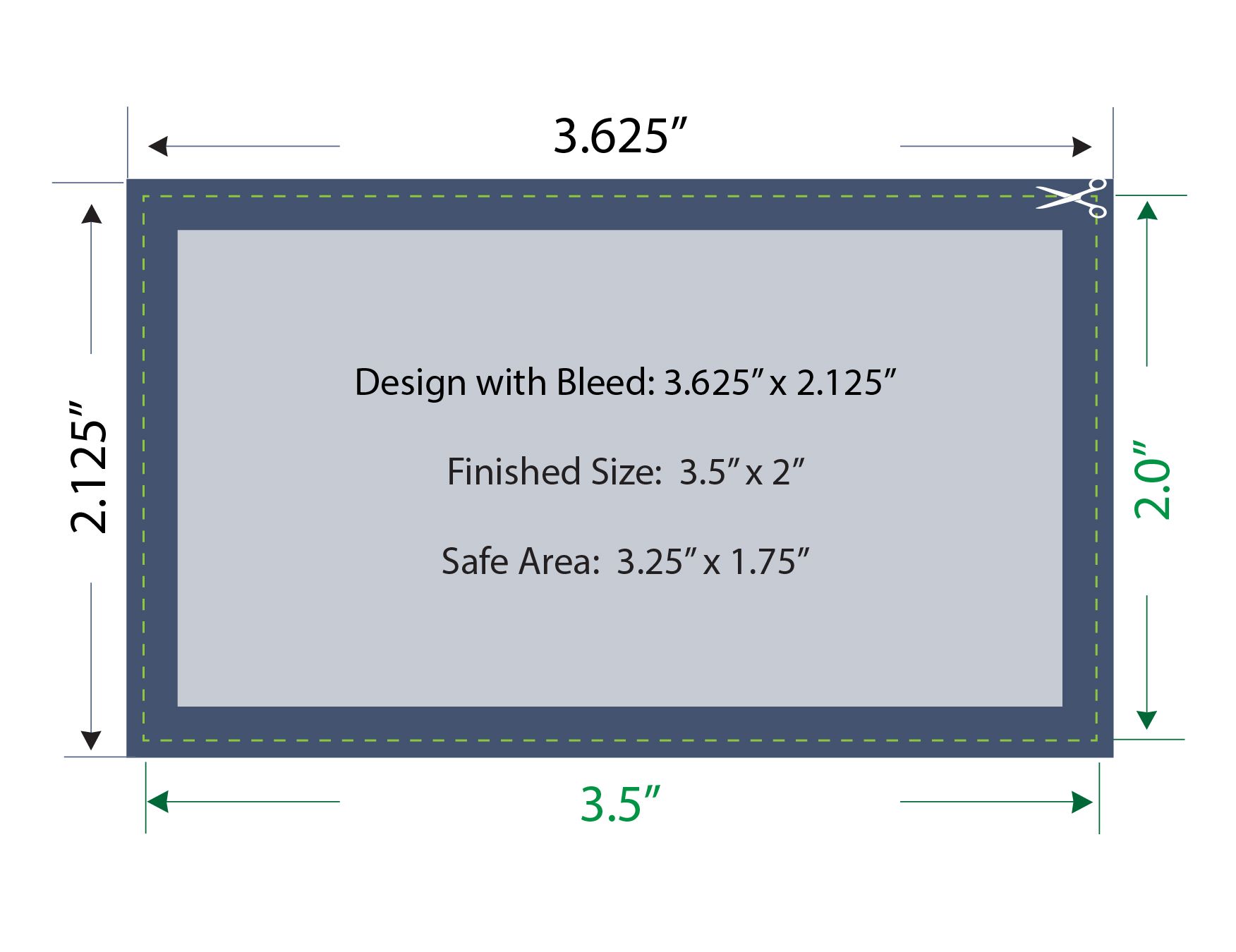

Dimensions:
Brothers Printing, Inc offers a standard business card size of 3.5" x 2". In order to print business cards from edge to edge the design needs to be with the bleed area of 1/8".
File:
We prefer a high-quality PDF, TIFF, JPG, or EPS. The raster images should be not less than 300 dpi and color profile in CMYK.
Templates:
We provide free business card templates online. With our online layout tool, you would be able to tailor your design at your convenience.
Paper type
When choosing paper for your business cards, several factors come into play. Weight, type of finish and color are just a few. You can also choose from different textures and thicknesses. Paper weight is a critical consideration when designing your business card because it affects the thickness and durability of the final product.
Lamination
Laminating your business card is a great way to protect it from wear and tear as well as potential damage by water or other liquids. It will also help prevent smudging or scratching in difficult conditions.
Rounding corners
With the round corners design, you can make your company stand out from the competition and give your business card a stylish and unique look.
Color Proof (RGB vs CMYK)
RGB (Red, Green and Blue) is the additive color model in which red, green and blue light are added together in various ways to reproduce a broad array of colors. In contrast, CMYK (Cyan, Magenta, Yellow and Black) is the process of printing color by using only four colors: cyan, magenta, yellow and black. The K represents the key color black.
Business Card Printing: A Complete Guide to Choosing the Right Cards for Your Business
Despite everything going digital, the business card hasn't disappeared — and it isn't likely to. At a networking event, a trade show, or a first meeting with a client, handing someone a well-made card still says something a phone screen can't: that you're prepared, established, and worth remembering. The catch is that not all business cards are created equal, and choosing the wrong paper stock, finish, or size can undercut the impression you're trying to make.
Here's what to actually consider when ordering business cards, and how to make sure yours work as hard as they can.
Standard Business Card Sizes
Most business cards printed in the U.S. follow a 3.5" x 2" standard size, which fits neatly into wallets, cardholders, and card scanners. Other common options include:
- Square cards (2.5" x 2.5"): Stand out visually and work well for creative or design-forward brands.
- Mini cards (3.5" x 1.5"): Compact and distinctive, often used as appointment or loyalty cards.
- European size (3.35" x 2.17"): Slightly narrower, common for businesses with international clients.
Sticking with the standard size is usually the safer choice unless a nonstandard shape supports your brand identity — an oddly sized card that doesn't fit a wallet can be more annoying than memorable.
Paper Stock and Weight
The weight and texture of the card stock has an outsized effect on how a business card feels — and by extension, how the business behind it is perceived.
- 14-16pt cardstock: The industry standard for a sturdy, professional card.
- 32-36pt cardstock: Extra thick and rigid, often used for premium or luxury branding.
- Uncoated stock: Has a natural, matte feel and takes pen ink well for handwritten notes.
- Recycled or cotton stock: Popular with brands that want to signal sustainability or craftsmanship.
A thin, flimsy card can undercut an otherwise strong design, while a heavier stock often reads as more established — even before someone reads a word on it.
Finishes and Printing Techniques
Finish options let a business card do more than list contact information — they add texture and visual interest that make a card worth holding onto:
- Matte finish: Non-reflective, smooth, and easy to write on.
- Glossy finish: Vibrant colors and a polished look, but shows fingerprints more easily.
- Soft-touch/velvet lamination: A distinctive, tactile finish that feels premium.
- Spot UV: Glossy raised accents over specific design elements, layered on a matte background for contrast.
- Foil stamping: Metallic gold, silver, or copper accents for a high-end look.
- Letterpress: Pressed, textured lettering that gives a card a handcrafted feel.
- Die-cutting: Custom shapes and rounded corners that break away from the standard rectangle.
Specialty finishes cost more per card, but for businesses in design, real estate, hospitality, or other image-conscious industries, they often pay for themselves in how memorable the card is.
What Every Business Card Needs
Regardless of size or finish, a business card should clearly include:
- Full name and title
- Company name and logo
- Phone number and email address
- Website URL
- Physical address, if relevant to the business
- Social media handles or a QR code, if useful
Resist the urge to cram in every possible detail. A cluttered card is harder to read and less likely to get a second glance — clean, legible design usually wins over cramming in more information.
Digital Add-Ons: QR Codes and NFC Cards
Business cards increasingly serve as a bridge between a physical handoff and a digital destination. A QR code or NFC (tap-to-share) chip on a card can link directly to a portfolio, booking page, or digital contact card — turning a one-time exchange into an easy way for someone to follow up. When adding one, link to a specific, useful page (like a scheduling link or portfolio) rather than just a generic homepage, and test the QR code across a few different phones before printing in bulk.
Ordering Business Cards: What to Check Before You Print
Before submitting a design for printing, it's worth double-checking a few things that are easy to miss:
- Bleed and margins. Designs with color or images extending to the edge need extra "bleed" space so nothing gets cut off during trimming.
- Resolution. Low-resolution logos or images can look blurry once printed, even if they look fine on a screen.
- Color mode. Designs should be in CMYK, not RGB, since printers use different color processes than screens.
- Proofread everything. A misspelled name, wrong phone number, or outdated address is one of the most common — and avoidable — printing mistakes.
- Order a sample or small batch first. For a first order with a new printer or a new design, a small proof run helps catch any surprises before committing to thousands of cards.
How Many Should You Order?
Order quantities usually range from 100 to 1,000+ cards, and cost per card typically drops significantly at higher volumes. As a rough guide:
- 100-250 cards: Good for freelancers, new businesses, or those testing a design.
- 500 cards: A common middle-ground order for small businesses and individual employees.
- 1,000+ cards: More economical for sales teams, growing businesses, or frequent networkers.
Since contact information and titles change, it's often smarter to order a moderate quantity more frequently than to over-order and risk cards becoming outdated.
Final Thoughts
A business card is a small object carrying a lot of responsibility: it's often the only physical thing someone walks away with after meeting you. Getting the size, stock, finish, and information right means that small card keeps working long after the conversation ends — sitting on a desk, in a wallet, or on a corkboard as a reminder to follow up.
Ready to print your business cards? [Get a quote] or explore our paper stocks, finishes, and design templates to find the right fit for your brand.
Popular business card template


please call us at
(916) 331-1101
Mon- Fri 9:00 am - 5:00 pm PST.